
Project Appetizers#
The following project topics are offered the General Engineering study line in 01004 Mathematics 1b this year (Spring 2026).
Reduction of Biological Complexity: PCA in Microbiome Studies#
How do you find meaning in data that contains thousands of different bacterial species from hundreds of soil samples? Microbiome research produces enormous amounts of complex data where it is impossible to notice or detect patterns with the naked eye. But in the data, biological patterns are in fact hidden, and behind those also lies a precise mathematical structure.
In this project we will not make do with just running finished Python libraries; rather, we will dive into the machine room of Principal Component Analysis (PCA) and PCoA. We will be working with the fundamental linear algebra that makes dimensional reduction possible. This means that we will master the theory behind covariance matrices, eigenvalues, and eigenvectors and understand how the spectral theorem ensures that we can find orthogonal axes that explain as much as possible of the variance in the data.
Throughout the project you will learn how to transform abstract mathematical theorems into practical Python code. We will be investigating how large data matrices are handled, how distance metrics are computed, and how plots such as:
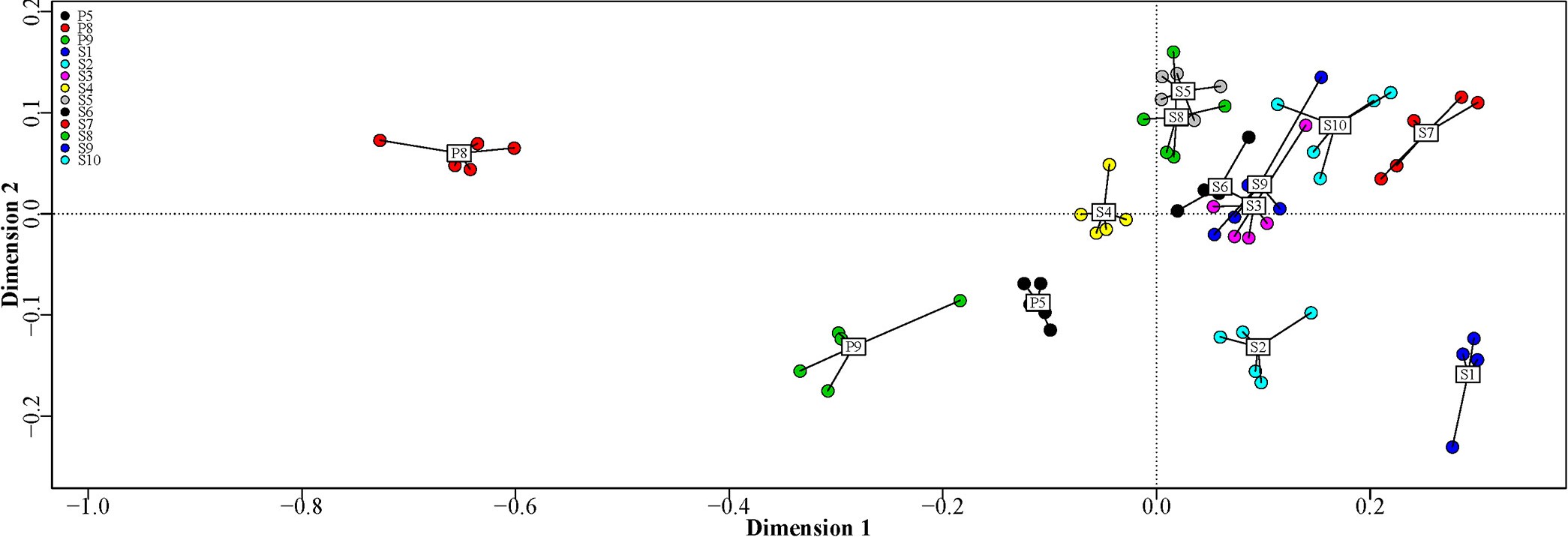
are interpreted. We will discover that the isolated clusters and patterns in our plots are not just visual randomness but rather the result of precise spectral decompositions of the biological measurements.
This project provides a chance to see how theory from the linear algebra is an absolute necessity for navigating life’s complexity.
Self-Driving Cars and Convoy Dynamics#
Traffic flow and the behaviour of cars are important factors in modern transportation. Following the development of self-driving cars, new challenges arise: How do we ensure stable and safe driving in a convoy of cars? What happens when a car suddenly brakes, and how does such change of one car propagate through the row of vehicles?

The purpose of this project is to analyze a simple mathematical model for self-driving cars in a convoy. Each car adjusts its acceleration based on the distance to the car ahead as well as their difference in speed. The model is described by the differential equation:
where \(v(t)\) is the speed of the car, \(x(t)\) its distance to the car ahead, and \(x^*(t) = Tv^+(t)\) is the desired distance.
Topics from the Math 1a and 1b course: Linear algebra, including eigenvalues and eigenvectors, linear second-order differential equations, systems of linear differential equations, and Taylor polynomials. The stability of solutions will also be a focus area in this project, a topic outside the syllabus of the Math 1 courses.
From a mathematical perspective, this project concerns analysis and solution of linear differential equations, stability investigations, as well as numerical simulations of the motion of the cars. To get started, have a read through this Wikipedia article that explains the idea behind the simple trapezoidal rule, which will be expanded into a cumulative version in the project: https://en.wikipedia.org/wiki/Trapezoidal_rule.
PageRank – The Mathematics behind Google’s Search Algorithm#
How is the order of search results decided on the internet? The PageRank algorithm as developed by Google makes use of mathematical models for ranking webpages based on their link structure.
In this project we will be investigating how websites can be represented as digraphs, how a link matrix is built, and how PageRank is computed using tools such as Markov chains and iterative techniques. Along the way we will be working with probability vectors, matrix multiplication, eigenvalues, the spectral theorem, time-discrete dynamics, and Python implementations of the algorithm.
The project combines mathematics, computer science, and applications in network analysis - a perfect chance to see theory in practice.